It's hard for me to think to a time when raw milk scared me. What was I afraid of? Illness? Death? Flavor?
In my head I am reviewing my college years of studying food and dietetics for that is certainly where the fear was nurtured. There was definitely a theme of food churned out of the standard food industry is much safer. But there were no studies or statistics presented to us to back up this practice pertaining to raw dairy products. I don't blame the professors. I think there are many mindless rules in various areas of our life we profess without stopping to investigate their truth. For example, does it really ruin your eyes to sit too close to the TV? Maybe it does, maybe it doesn't. But honestly, it's not something I have seen researched.
I'd love to get on my raw milk soap box but first I will share a wonderful fact sheet that Judith Mc Greary of the Farm and Ranch Freedom Alliance compiled. I took the liberty of editing out some of the local economic benefit to make it easier on you guys to read. Not that you all are not capable of understanding, but rumor has it that most of you are not as interested as I am in all the details :).
FYI there is a bill in Austin right now that we are working to get passed that will allow farmers to bring their raw milk to sale at farmer's markets and it will also allow delivery of milk to homes. As it stands right now, raw milk is a safe and legal food product but legislation has made it difficult to obtain. The law states that you must drive to the farm to get your raw milk. That's not very convenient for most of us and this inconvenience cuts into the farmer's potential sales as well as our right to choose our own food source.
Grade A Raw Milk In Texas
Economic Benefits of Raw Milk
Direct farm-to-consumer sales of raw milk can mean the difference between a net loss on the farm and the ability to provide a reasonable income for the farm family. Below are numbers drawn from actual Texas dairy farmers. These numbers do not cover the full range of potential situations, but provide a sample of the real-world economics of dairy.
Every $1 earned on the farm equates to $5-$7 for the local community. By providing a fair income for rural dairy farmers, Grade A sales of raw milk can help our struggling rural economies.
In 2002, dairy farms in the U.S. went out of business at the rate of 16 farms per day. Dairy farms are currently facing a crisis.
Existing Regulations
Licensed farmers can sell raw milk directly to consumers under Chapter 435 of the Health Code. HB 75/ SB 237 is narrowly tailored to address the marketing barrier created by the current restriction on the location of sales. It does not change any of the extensive regulations placed on Grade A producers that address health and safety concerns, found at 25 TAC Chapter 217. Below are some highlights of the existing regulations that would remain unchanged.
• Dairy farms, both facilities and records, are inspected twice every 6 months (217.26a)
• If a condition is found that poses an imminent health hazard, the department is required to suspend the dairy’s permit immediately (217.26d)
• Samples of the milk are collected at least every six weeks and tested for: bacterial counts, coliform counts, somatic cell counts, water adulteration, and cooling temperatures. (217.27)
• At least twice every six months, the samples are also tested for pathogenic bacteria
• At least four times every six months, the samples are also tested for antibiotics
• Grade A raw milk must meet the following standards (217.28)
• Cooled to 45 degrees or less within 2 hours (also regulated in 217.29s).
• Somatic cell counts not to exceed 750,000 per milliliter (ml) for cow’s milk or 1,000,000/ml for goat’s milk.
• Bacteria limits of 20,000 per ml (not applicable to cultured products).
• Coliform not to exceed 10 per ml.
• Pathogen limit of zero.
• Section 217.29, Sanitization Requirements for Grade A Raw Milk, has 20 subparts, which have in turn multiple sub-subparts, of rules (217.29). Some highlights include:
• Abnormal milk shall be discarded, and animals which show evidence of abnormal secretion must be isolated from the non-abnormal milk and equipment cleaned (a)
• Milk barn must meet detailed construction and cleanliness requirements (b,c, e-g)
• Animal yard shall be properly graded to prevent standing pools of water or waste, housing areas maintained to prevent soiling of animals udders and flanks (d)
• Clean water in sufficient quantity for the dairy operations (h)
• Containers, utensils and equipment must meet standards for construction (type of materials), cleaning, sanitization, storage and handling (i-m)
• The animal and the milking equipment must be free from contamination (n-p)
• People doing the milking must have clean hands, wear clean outer garments, and be free of infection (q, r)
• Effective insect and rodent control is required (t)
• Animal Health: All herds shall be tested and found free of tuberculosis and brucellosis before any milk is sold; herds shall be retested at least every 12 months; cattle herds participate in brucellosis ring testing by Texas Animal Health Commission. For other diseases, the department may require physical, chemical, or bacteriological tests. (217.20)
• Plans for Grade A Raw for Retail Milk Dairy Farms shall be submitted to the department for approval before work is begun (217.30).
Safety of Raw Milk
• EXCELLENT SAFETY RECORD IN TEXAS: Raw milk has an excellent safety record in Texas. According to the CDC, between 1998 and 2008, there were only two reported cases of illness from raw milk. In contrast, during the same time period, there were 465 illnesses reported just from raw oysters. In fact, there were over 12,000 foodborne illnesses reported in Texas in that time period (not including multi-state outbreaks), traced to such foods as strawberries, mangos, ice cream, cake, beans, lettuce salads, salsa, cheeses, pot pie, chicken salad, hot dogs, deli meats, and beef brisket. Any food carries some risk of foodborne illness, but as shown above (see Existing Regulations), licensed raw milk farmers take extensive precautions to ensure the safety and quality of their product.
• OTHER STATES: Sales of raw milk are legal in more than half of the States. Ten States allow the sale of raw milk in grocery stores, which would not be allowed under HB 75/ SB 237.
• PROTECTIVE COMPONENTS OF UNPROCESSED MILK: Raw milk contains numerous components that assist in:
o Killing pathogens in the milk (lactoperoxidase, lactoferrin, leukocytes, macrophages, neutrophils, antibodies, medium chain fatty acids, lysozyme, B12 binding protein, bifidus factor, beneficial bacteria);
o Preventing pathogens from being absorbed across the intestinal wall (polysaccharides, oligosaccharides, mucins, fibronectin, glycomacropeptides, bifidus factor, beneficial bacteria); and
o Strengthening and modulating the immune system (lymphocytes, immunoglobulins, antibodies, hormones and growth factors).
o Note that breast milk is raw. The safety and health benefits of breast milk have been well documented.
• LOSS OF PROTECTIVE COMPONENTS DUE TO PASTEURIZATION: Many of these anti-microbial and immune-enhancing components are greatly reduced in effectiveness by pasteurization.
• MODERN ADVANTAGES IN RAW DAIRY PRODUCTION: Compared to 50 years ago, dairy farmers today can take advantage of many advancements that contribute to a much safer product, including rotational pasture grazing, milking machines, effective cleaning systems, and refrigeration. Milk and herd disease testing techniques are also more thorough than when pasteurization became commonplace.
Health Benefits of Raw Milk
• ASTHMA AND ALLERGIES: Several recent studies in Europe have found that drinking “farm” (raw) milk protects against asthma and allergies.
• RAW HUMAN MILK: Infants and premature babies on pasteurized human milk did not gain weight as quickly as those fed raw human milk; problems were attributed to pasteurization’s destruction of lipase. In another study, neonates given raw human milk had a markedly lower incidence of infection than those who received pasteurized human milk and formula.
• POSITIVE TESTIMONIALS: There are hundreds of testimonials involving reversal of failure to thrive in infants; allergies, asthma and behavior problems in children; and digestive disorders, arthritis, osteoporosis and even cancer in adults.
• NUTRIENTS RETAINED IN RAW MILK:
Vitamin A
Beta-lactoglobulin, a heat-sensitive protein in milk, increases intestinal absorption of vitamin A. Heat degrades vitamin A.
B Vitamins (incl. folate)
Significant percentages of Vitamins B6, B12, thiamin and folate are destroyed by heat treatment, although the specific percentages found vary from study to study. In addition, the folacin-binding protein in raw milk is rendered ineffective during pasteurization and processing.
Vitamin C
Heating leads to a loss of Vitamin C in pasteurized milk. “Without doubt, the explosive increase in infantile scurvy during the latter part of the 19th century coincided with the advent of use of heated milks and proprietary foods. … Hess [a pediatrician] was able to effect a cure for scurvy by providing raw milk or orange juice or potatoes.”
Vitamin D
Vitamin D is present in milk in protein-bound form, which may be lost during pasteurization.
For some reasont the resources did not copy into this post. I'll try to get them up in another post soon.

Showing posts with label Dairy. Show all posts
Showing posts with label Dairy. Show all posts
Wednesday, February 9, 2011
Monday, February 7, 2011
Cheesecake Reviewed
You may have noticed I review recipes as much as I post recipes. And while I do like to share my recipes (I have a new creation in the works right now) I also like discuss the numerous ones already out there. And often I will review recipes From Nourishing Traditions by Sally Fallon because almost everyone I know owns this recipe book and cooks from it. Since it has over 700 recipes it just makes since to share my favorites (or least favorites) with my friends so you don't have to make all 700 by yourself to find the best.
Now for the good part. Let's talk dessert.
Just the other day a friend and I were discussing how we rarely take the time to make an awesome whole food dessert. The reason being that if we are taking the time to make something from scratch out of high quality ingredients then it should be for dinner. But what if the dessert was nourishing and not just a not-as-bad-for-you-as-the-original-version substitute (think organic oreo, it's still not "good for you" it's just not as bad).
And then it came to be that I had extra homemade cream cheese in my refrigerator that needed a purpose. Flipping through my NT cookbook on page 566 I found the recipe for All-Raw Cheese Cake that I had been wanting to try. Just then the phone rang and my father-in-law gave me the assignment of bringing a dessert to the Super Bowl party. Providence! Lord bless him because he really is a brave soul asking me to bring food. Not that my food is bad by any means but one must be willing to be adventurous and think outside the Sara Lee box.
This recipe is pretty simple and does not require rare hard to find ingredients. The only difficult part is the fact that a food processor is needed and although they are simple to use, they are a pain to clean. Overall I would rate this recipe as easy. After all, you don't even have to bake it!
The crust is made of pureed almonds and dates. Oh YUM! It even stuck together without baking, and I was sceptical in the beginning. The cheese portion of the cake was delicious, rich, creamy, and everything you dream a cheesecake should be...until I added the fluffy egg whites. It wasn't "bad" after the egg whites but it did dilute the sweet richness. Next time I would leave the egg whites out but if you are looking for a less sweet and lighter, fluffier product then by all means add the egg whites.
Now, there is a saying around here when it comes to sweets. "Is it Christina sweet or real people sweet?" After all, I do find a carrot or sweet potato plenty sweet. I think without the egg whites the level of sweetness is intensified and adequate. The recipe only calls for 1/2 cup of raw honey for a large cheesecake and I found the product wonderfully rich before the egg whites. After the egg whites all flavors were diluted. I might even consider a little more honey if using the egg whites. But to be honest I probably didn't put the whole 1/2 a cup because I never do put the full amount of sweeteners in recipes. It's just a habit.
Overall this a decadent nourishing food! Dates, almonds, raw milk, homemade cream cheese, and a little raw honey are an amazingly wonderful way to get in a varitey of vitamins, minerals, good fats, protein, and fiber. I think we have discovered how to have your cake and eat it too! You had to know that cliche was coming .
Now for the good part. Let's talk dessert.
Just the other day a friend and I were discussing how we rarely take the time to make an awesome whole food dessert. The reason being that if we are taking the time to make something from scratch out of high quality ingredients then it should be for dinner. But what if the dessert was nourishing and not just a not-as-bad-for-you-as-the-original-version substitute (think organic oreo, it's still not "good for you" it's just not as bad).
And then it came to be that I had extra homemade cream cheese in my refrigerator that needed a purpose. Flipping through my NT cookbook on page 566 I found the recipe for All-Raw Cheese Cake that I had been wanting to try. Just then the phone rang and my father-in-law gave me the assignment of bringing a dessert to the Super Bowl party. Providence! Lord bless him because he really is a brave soul asking me to bring food. Not that my food is bad by any means but one must be willing to be adventurous and think outside the Sara Lee box.
This recipe is pretty simple and does not require rare hard to find ingredients. The only difficult part is the fact that a food processor is needed and although they are simple to use, they are a pain to clean. Overall I would rate this recipe as easy. After all, you don't even have to bake it!
The crust is made of pureed almonds and dates. Oh YUM! It even stuck together without baking, and I was sceptical in the beginning. The cheese portion of the cake was delicious, rich, creamy, and everything you dream a cheesecake should be...until I added the fluffy egg whites. It wasn't "bad" after the egg whites but it did dilute the sweet richness. Next time I would leave the egg whites out but if you are looking for a less sweet and lighter, fluffier product then by all means add the egg whites.
Now, there is a saying around here when it comes to sweets. "Is it Christina sweet or real people sweet?" After all, I do find a carrot or sweet potato plenty sweet. I think without the egg whites the level of sweetness is intensified and adequate. The recipe only calls for 1/2 cup of raw honey for a large cheesecake and I found the product wonderfully rich before the egg whites. After the egg whites all flavors were diluted. I might even consider a little more honey if using the egg whites. But to be honest I probably didn't put the whole 1/2 a cup because I never do put the full amount of sweeteners in recipes. It's just a habit.
Overall this a decadent nourishing food! Dates, almonds, raw milk, homemade cream cheese, and a little raw honey are an amazingly wonderful way to get in a varitey of vitamins, minerals, good fats, protein, and fiber. I think we have discovered how to have your cake and eat it too! You had to know that cliche was coming .


Monday, January 10, 2011
Warm Up To Melanie
I realized a moment ago as I curled up with one of my favorite comforting hot beverages on this snowy night, that I cannot keep this secret to myself. I must go now and blog this simple cozy recipe. Now!
Here is how you make a Melanie.
Warm raw milk on the stove just enough that it is pleasurable to drink. Be careful not to get it too hot and pasteurize it! (Gosh I wish I could see people's faces when they read that :) If it's boiling, you've gone too far.
Pour into your favorite mug and add a drop of pure organic vanilla. As you stir be sure to take in that soothing aroma. The smell alone is almost as comforting as being wrapped in the quilt my grandmother made for me. Almost.
This warm creamy beverage was named by my myself and my old best friend, Carly in Junior High after a beloved character from our favorite movie at the time. The character was genuinely sweet, not too sweet mind you, reliable, comforting, and nourishing. Okay, I must tell you that is was Melanie Hamilton from Gone With The Wind. Cheesy, isn't it? None the less, you will love it!
Here is how you make a Melanie.
Warm raw milk on the stove just enough that it is pleasurable to drink. Be careful not to get it too hot and pasteurize it! (Gosh I wish I could see people's faces when they read that :) If it's boiling, you've gone too far.
Pour into your favorite mug and add a drop of pure organic vanilla. As you stir be sure to take in that soothing aroma. The smell alone is almost as comforting as being wrapped in the quilt my grandmother made for me. Almost.
This warm creamy beverage was named by my myself and my old best friend, Carly in Junior High after a beloved character from our favorite movie at the time. The character was genuinely sweet, not too sweet mind you, reliable, comforting, and nourishing. Okay, I must tell you that is was Melanie Hamilton from Gone With The Wind. Cheesy, isn't it? None the less, you will love it!
Wednesday, October 13, 2010
Texas Daily Harvest
You may have heard me talk about this dairy in my nutrition class or read about them on my blog. Now you can check them out for yourself. Their website is up and running now so pop on over, texasdailyharvest.com. You might be surprised to find that a store or farmer's market near you is carrying their delicious products. Archer's personal favorite is their Greek yogurt. My new favorite is their Gouda cheese that I tried for the first time last night. I made a cheese soup with the organic Gouda, fresh raw cream, homemade broth, and veggies. You can't do better than nourishing and amazingly tasty food! Don't forget, if you don't see your local store listed on Texas Daily Harvest's website, you can always ask your store to carry their products. Sprouts, Whole Foods, and small health food stores are always looking for high quality local products.
Click here to receive the Texas Daily Harvest newsletter. A certain dietitian that you know is writing articles for their newsletters ;).
Enjoy the harvest!
Click here to receive the Texas Daily Harvest newsletter. A certain dietitian that you know is writing articles for their newsletters ;).
Enjoy the harvest!
Tuesday, October 12, 2010
Real Milk For Everyone
A new bill is in the works that would allow raw milk to be sold at farmer's markets, farm stands, and to be delivered. Under current law raw milk can only be sold at the farm. I know for us that means driving at least 1 hour there and 1 hour back. And in my book that's a little difficult to add to our weekly excursions to say the least. That's why we have set up a milk co-op where we take turns driving out to the farm.
This law will help support local farms and in effect the local economy. And as an added bonus it allows the consumer easier access to real unprocessed food. Why do they make it so hard in the first place to get food that doesn't say General Mills or Nabisco on it?
For more details and to find out how you can help click here.
This law will help support local farms and in effect the local economy. And as an added bonus it allows the consumer easier access to real unprocessed food. Why do they make it so hard in the first place to get food that doesn't say General Mills or Nabisco on it?
For more details and to find out how you can help click here.
Monday, October 4, 2010
Butter 'Em Up!
I don't know about you but I have not had much luck making butter in a food processor. Maybe I'm just not patient enough or perhaps I just can't take that loud noise long enough for the butter to actually form. But the benefits of homemade butter made from farm fresh cream are worth my effort. Omega 3's from grass fed cows, fat soluble vitamins, and brain building cholesterol linger in the heavy cream awaiting transformation. Note to dairy friends: there are several of us that are willing to pay for farm fresh butter made from the raw cream of grass fed cows! Please fill this niche.
Until a dairy takes on this endeavor I must endure. Or put the children to work. Last week I set my cream out for 8 hours to sour (Think probiotics. Cultured dairy products are awesome, not scary. I promise). I then placed the cream in a clean glass jar and screwed the lid on tight. Very tight.
After that, I handed it over to the kids. They rolled it back and forth, took turns shaking the jar, and even fought over it. Did you know that making butter actually encourages crawling? Archer would play with the jar and as it rolled away from him he would go after it. Yet another great thing about butter! We even took it outside and rolled it around the yard. We had butter in no time at all!


I guess I should have taken a picture of the butter when we were finished, huh?
For the sake of food science I must tell you that the constant shaking and moving of the cream causes the fat globules to stick together and form butter. After your butter has clumped together place it in a clean glass dish. Pour a little water over the butter to wash it and then press the butter with a spatula, paddle, or wooden spoon to remove excess water. We store our cultured butter on the counter so it's ready to spread.
Until a dairy takes on this endeavor I must endure. Or put the children to work. Last week I set my cream out for 8 hours to sour (Think probiotics. Cultured dairy products are awesome, not scary. I promise). I then placed the cream in a clean glass jar and screwed the lid on tight. Very tight.
After that, I handed it over to the kids. They rolled it back and forth, took turns shaking the jar, and even fought over it. Did you know that making butter actually encourages crawling? Archer would play with the jar and as it rolled away from him he would go after it. Yet another great thing about butter! We even took it outside and rolled it around the yard. We had butter in no time at all!


I guess I should have taken a picture of the butter when we were finished, huh?
For the sake of food science I must tell you that the constant shaking and moving of the cream causes the fat globules to stick together and form butter. After your butter has clumped together place it in a clean glass dish. Pour a little water over the butter to wash it and then press the butter with a spatula, paddle, or wooden spoon to remove excess water. We store our cultured butter on the counter so it's ready to spread.
Tuesday, September 14, 2010
Bring on the rain
Our weekly delivery of milk from our dairy co-op came the other day. Mark poured a glass for me after dinner the other night.
The extra rich and creamy milk hit my mouth with a bit of a surprise. "Did you shake it I asked?" Since we buy raw milk straight for the dairy you must always shake it before you pour because the cream rises to the top.
"Yes," he replied.
I took another sip and was sure of the indulgence this cup held. Again I inquired, "Are you sure you poured a glass of milk? You know I have cream in there as well."
"It's milk. I'm sure." And then he sips, "Wow. That's good stuff."
Apparently, the recent rains have had an effect on the cows diet. Both our cow milk and goat milk have been especially rich this past week. And the twang of late summer goat milk is gone replaced by a richer texture and improved flavor. If you have not tried raw milk before, now is a great time.
All this fat and cholesterol will go straight to Archer's head! With me drinking this nutrient rich milk, my milk is now fortified even more with brain food for Arch!
Find a dairy near you that provides raw fresh milk from grass-fed cows at realmilk.org.
The extra rich and creamy milk hit my mouth with a bit of a surprise. "Did you shake it I asked?" Since we buy raw milk straight for the dairy you must always shake it before you pour because the cream rises to the top.
"Yes," he replied.
I took another sip and was sure of the indulgence this cup held. Again I inquired, "Are you sure you poured a glass of milk? You know I have cream in there as well."
"It's milk. I'm sure." And then he sips, "Wow. That's good stuff."
Apparently, the recent rains have had an effect on the cows diet. Both our cow milk and goat milk have been especially rich this past week. And the twang of late summer goat milk is gone replaced by a richer texture and improved flavor. If you have not tried raw milk before, now is a great time.
All this fat and cholesterol will go straight to Archer's head! With me drinking this nutrient rich milk, my milk is now fortified even more with brain food for Arch!
Find a dairy near you that provides raw fresh milk from grass-fed cows at realmilk.org.
Monday, August 30, 2010
What's up with Little Miss Muffet's cusine of choice?
Little Miss Muffet sat on her tuffet eating her curds and whey. There came a big sp...wait. Back up. Curds and whey? What in the world is that all about?
Definitions:
Curds- the thick casein-rich coagulated part of milk
Whey- the watery part of milk that has separated from the coagulated part of milk.
It all sounds pretty nasty right? Here is what I see when I read the definition.
Curd- mouth-watering creamy cheeses offering a variety of fat soluble vitamins, life sustaining protein, and an invaluable ingredient to pleasurable and nourishing cooking.
Whey- rich in vitamins and minerals, this substance has been used for thousands of years as a catalyst in lactofermentation. Lactofermentation was the original probiotic.
Sounds a bit more interesting now.
Even if you are just beginning to embark on the journey of good health this is a good place to start. Those of you who are a little farther down the path will find this is a great place to take the next plunge. Listed below are the steps for making your own curds and whey. By the end you will have delicious homemade cream cheese and whey. The cream cheese can be used on sandwiches, in recipes, for sauces, dips, or any other way you would use store bought cream cheese. They whey can be saved to inoculate recipes for lactofermentation. I will be posting more about the wonderful beneficial world of lactofermentation with instructions and pictures later this week. But for now you can take the first step and then kick back and enjoy the creamiest of cheeses.
Step 1
If you do not have homemade yogurt then I recommend buying this brand. It seems to provide the most whey and satisfactory cream cheese. If you buy just any old store brand of yogurt you will have trouble. Only buy high quality. And remember to always buy whole milk.

Step 2
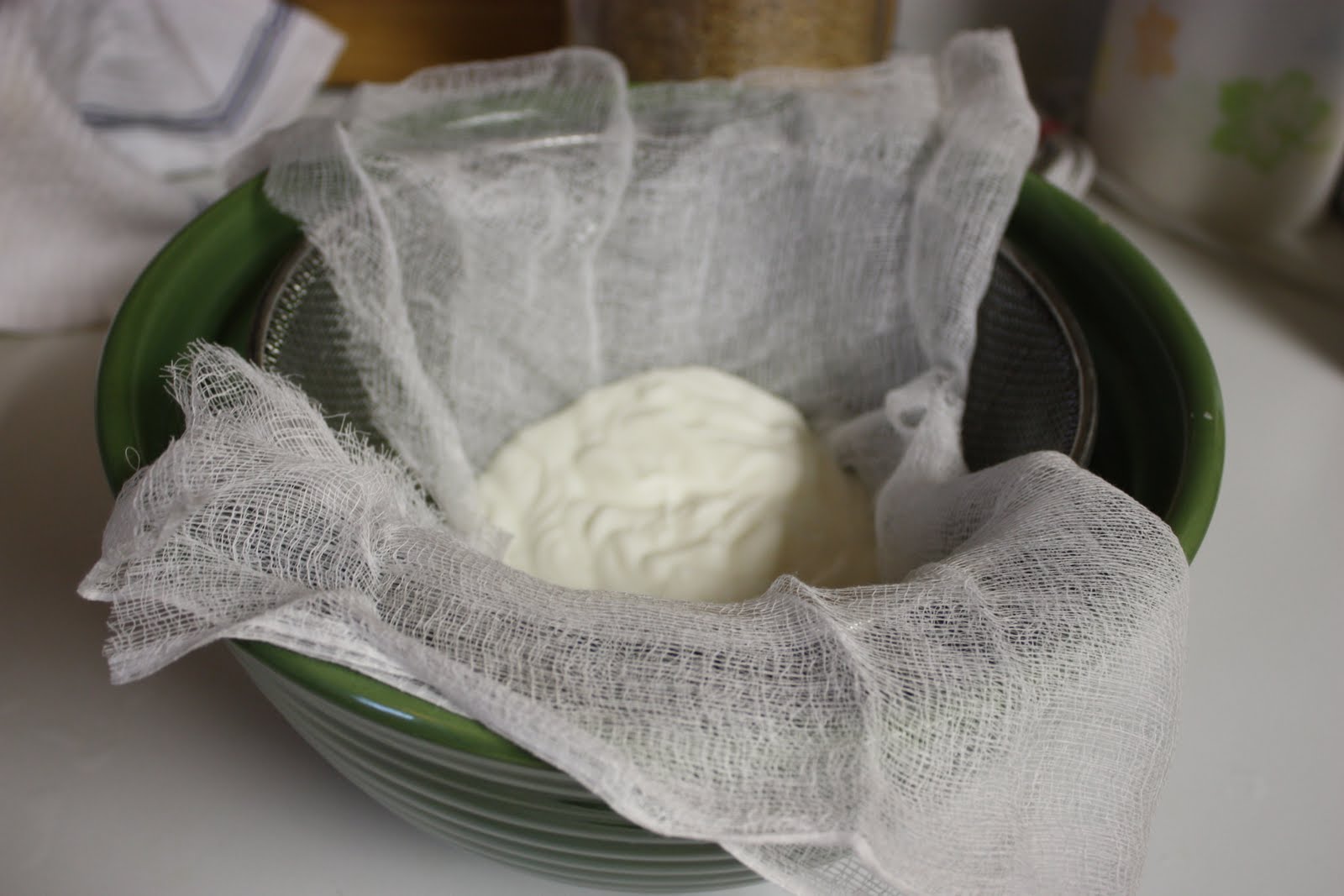
Put a metal strainer in a large bowl (not plastic).

Step 3
Cover the strainer with cheese cloth or a thin, clean dish towel and pour yogurt in.

Step 4
Cover with another clean dish towel and let sit on the counter at room temperature for several hours. The whey will start to drip through and collect in the bowl. Once the whey reaches the height of the strainer you will need to lift the curd higher. Tie the dish towel or cheese cloth up with twine and then tie it to a rod or wooden spoon. This will allow more whey to drip out. This process usually takes 24 hours from start to finish.

Step 5
When it stops dripping you can collect your cream cheese. It will keep in your fridge for about 1 month.

Step 6
Pour your whey in a clean glass jar and label with the date. Store this in your refrigerator up to 3 months.

Next up...what to do with this nutrition goldmine masquerading as an odd watery discharge!
Definitions:
Curds- the thick casein-rich coagulated part of milk
Whey- the watery part of milk that has separated from the coagulated part of milk.
It all sounds pretty nasty right? Here is what I see when I read the definition.
Curd- mouth-watering creamy cheeses offering a variety of fat soluble vitamins, life sustaining protein, and an invaluable ingredient to pleasurable and nourishing cooking.
Whey- rich in vitamins and minerals, this substance has been used for thousands of years as a catalyst in lactofermentation. Lactofermentation was the original probiotic.
Sounds a bit more interesting now.
Even if you are just beginning to embark on the journey of good health this is a good place to start. Those of you who are a little farther down the path will find this is a great place to take the next plunge. Listed below are the steps for making your own curds and whey. By the end you will have delicious homemade cream cheese and whey. The cream cheese can be used on sandwiches, in recipes, for sauces, dips, or any other way you would use store bought cream cheese. They whey can be saved to inoculate recipes for lactofermentation. I will be posting more about the wonderful beneficial world of lactofermentation with instructions and pictures later this week. But for now you can take the first step and then kick back and enjoy the creamiest of cheeses.
Step 1
If you do not have homemade yogurt then I recommend buying this brand. It seems to provide the most whey and satisfactory cream cheese. If you buy just any old store brand of yogurt you will have trouble. Only buy high quality. And remember to always buy whole milk.

Step 2
Put a metal strainer in a large bowl (not plastic).

Step 3
Cover the strainer with cheese cloth or a thin, clean dish towel and pour yogurt in.
Step 4
Cover with another clean dish towel and let sit on the counter at room temperature for several hours. The whey will start to drip through and collect in the bowl. Once the whey reaches the height of the strainer you will need to lift the curd higher. Tie the dish towel or cheese cloth up with twine and then tie it to a rod or wooden spoon. This will allow more whey to drip out. This process usually takes 24 hours from start to finish.

Step 5
When it stops dripping you can collect your cream cheese. It will keep in your fridge for about 1 month.

Step 6
Pour your whey in a clean glass jar and label with the date. Store this in your refrigerator up to 3 months.

Next up...what to do with this nutrition goldmine masquerading as an odd watery discharge!
Subscribe to:
Posts (Atom)